
Team honoured for transforming care for older adults

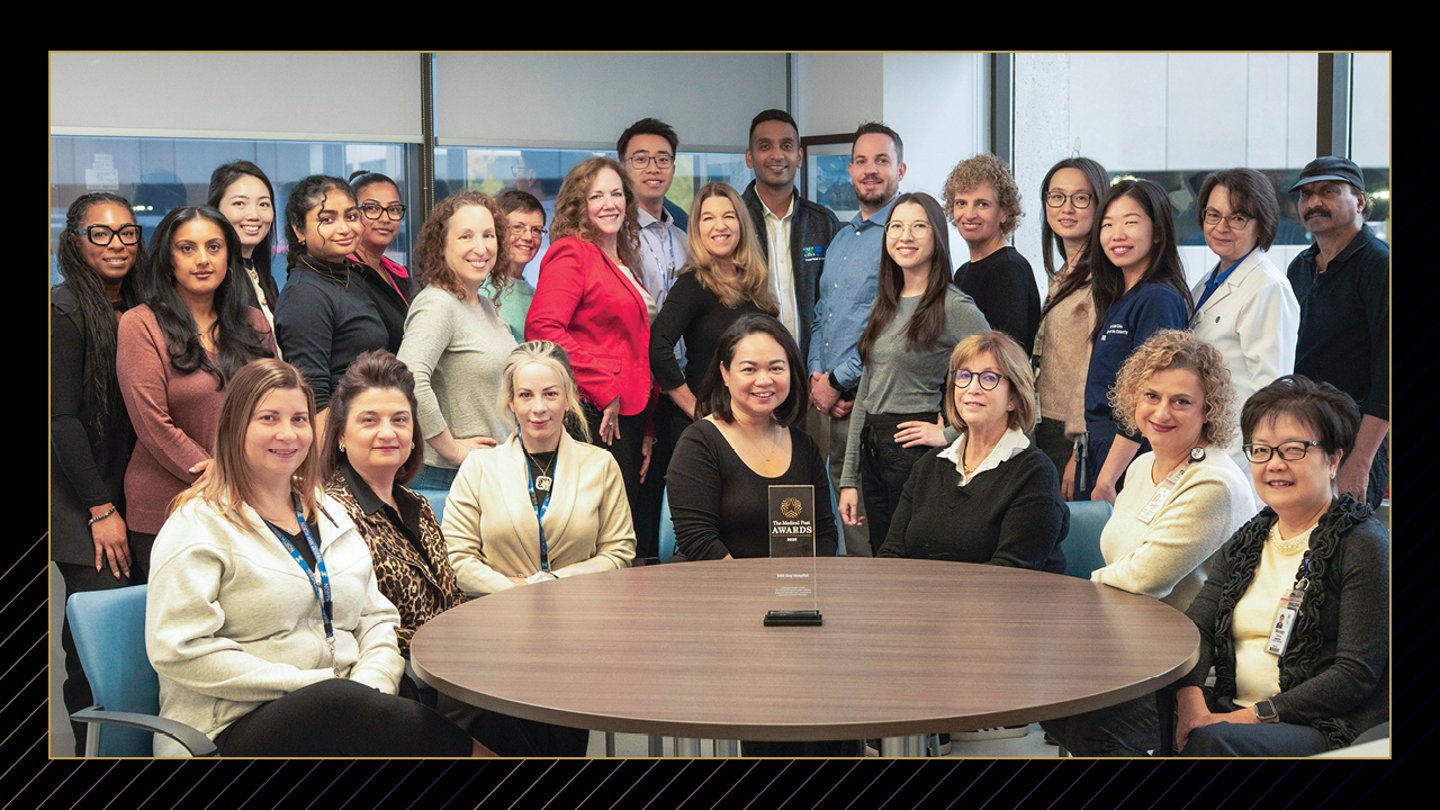
North York General Hospital’s Specialized Geriatric Services (SGS) Geriatric Day Hospital (GDH) interprofessional team has won the Medical Post Interprofessional Team Award for its exceptional work in advancing care for older adults.
The award highlights the team’s commitment to interprofessional collaboration, person-centered care and clinical excellence.
NYGH offers a continuum of geriatric services for in-patients to out-patient older adults. SGS has served community dwelling older adults with complex health needs since the 1980s. The GDH is a specialized program under this umbrella of services. GDH team’s approach focuses on comprehensive assessments, goal-oriented rehabilitation, education and compassionate support. This integrated model helps clients maintain their independence, improve their quality of life and continue living in their homes.
The team’s success is a result of deep collaboration among a diverse group of professionals, including physicians, nurses, physiotherapists, occupational therapists, dietitians, pharmacists, social workers, recreational therapists and more. They work together to understand each client’s needs and co-create treatment goals. This collective approach ensures coordinated and holistic care tailored to what matters most to each individual.
Medical Post Awards
The Medical Post Awards recognize Canadian doctors and are selected by panels of physician juries. Coverage of this year’s recipients is here: The 2025 Medical Post Awards winners.
The team’s dedication was especially evident during the COVID-19 pandemic. They quickly adapted to provide virtual check-ins and remote programming, ensuring vulnerable older adults were not left behind and had the support and connection they needed. This flexibility and compassion during a time of uncertainty highlighted their commitment to their clients.
Beyond the pandemic, the team continues to innovate by offering remote access options for group exercise classes and other programming. This initiative addresses transportation barriers and ensures that all clients can stay engaged and connected, helping to reduce social isolation.
Over the past five years, the team’s work has led to significant outcomes, including reduced hospital admissions and emergency room visits, prevention of premature institutionalization, and enhanced functional independence. A caregiver for a recent client shared, “I can’t thank you enough for the team and wish you all (every success) and hopefully (there will be) an expansion to this program so many more seniors like my dad can benefit.”
The GDH team stands as a model for what is possible when professionals unite with a shared purpose, setting a new standard for excellence in healthcare.
Judge quote: “The Geriatric Day Hospital at North York General Hospital manifests the spirit of interprofessionalism to achieve real world outcomes that benefit its patients, their families and the healthcare system at large.”
- Q&A
• Dr. Serina Dai, physician with the program
• Roula Mandas, social worker with the program
Q: Given burnout and the healthcare system struggling, what do you see about the value of recognition for programs like these?
Dr. Dai: We know that burnout is a big issue in the healthcare system, and it’s something we’re struggling with. I think in a system that’s stretched this thin, it’s easy for the work of allied health professionals to go unnoticed. But they’re often the ones who are working side-by-side with patients every day. In our program they help them walk, regain confidence, eat properly, manage their medications, and recognition, even as small as a thank you, is a reminder that what they’re doing is making a real difference.
Mandas: The team is very fortunate to work closely with our group of physicians. We’re very fortunate to have such a strong physician group. There’s a mutual respect and trust for everyone’s role on the care team, and this culture of appreciation and inclusivity leads to better teamwork, communication and improved patient outcomes. It’s very fun.
Q: Talk about your community and how an award like this helps the community?
Dr. Dai: So our community is quite large; it’s truly an interprofessional program. Roula is our social worker, I’m the physician, we have a pharmacist, occupational therapist, physiotherapist, recreational therapist. We have a nurse, a dietitian, rehab assistants and then we work closely with our Ontario Health at Home Care Coordinator at our weekly rounds.
The Medical Post Awards helps to bring attention to the work that’s often outside of the spotlight, and it helps to attract more people into these professions, because it’s something that we desperately need.
Q: What inspires you about the healthcare profession, and what motivates you to keep doing this kind of work?
Dr. Dai: It’s the patients. We’ve always been inspired by their strength and determination. Many of them are living with complex health issues, and they still show up every week or twice a week to try to meet their goals. At our program, we try to tailor a care plan based on their goals, like being able to cook independently or even just to go to the cottage with their family in the summer.
The outcomes speak for themselves. Our research has shown that programs like these help to improve, not just falls prevention and balance, but mood and chronic disease management and their ability to stay at home and function independently.
Mandas: Being part of an interprofessional team reminds me daily that I’m an integral piece of an important whole that helps people. What keeps me motivated is the collaboration itself. In our team, every voice matters, and we learn from one another, challenge each other, celebrate each other’s wins, and when a patient walks out with renewed confidence or a caregiver really feels empowered, it’s not just one discipline that made this happen, it’s all of us working together.
Q: Tell us about a challenge that you’re sort of facing leading change in healthcare, and how you’re overcoming it?
Dr. Dai: A very common challenge that our team faces in this healthcare system is trying to focus on preventative, proactive community-based care versus a healthcare system where it’s a system that often only steps in when there’s a crisis. So, we try to emphasize, home safety assessments by occupational therapists; we support caregivers; our pharmacists work with the primary care physician to optimize medications and we try to develop engagement strategies and behavioral activation and schedules for our patients at home, so that we can try to reduce emergency room visits and moving into long-term care.
Mandas: I think sometimes trying to be proactive also has to lend itself to trying to cut through a lot of fragmented care that also exists in healthcare. We talk a lot about how we have older adults that we’re caring for with medical, physical, social, psychological, cognitive, complex needs and the system doesn’t really support having coordinated care. So one of our biggest strengths, in addition to trying to help our clients, is also cutting through red tape, advocating and trying to speak as loudly as we possibly can in order to make sure that we are preventing any risks that a client might be experiencing in the community, finding new resources, thinking about creative ways how to support these patients.
Q: Is there a particular patient you recall where there was a strong impact?
Mandas: We recently had a 94-year-old living alone in her apartment. She had suffered a number of falls due to her impaired balance, and she’d been assessed as being safe for using a wheelchair. Unfortunately, her apartment was not accessible to a wheelchair. Her family really wanted her to stay at home. She came to us, to our program, as a last resort for improving her balance and safety, so she could remain at home. Tall order for sure. While in the program, she participated in rehab, focusing on balance and strengthening. We looked at safety and community resources, as well as family support, and we had a number of family meetings with our patient family team and physician, reviewing progress and goals.
We also wanted to ensure we were not setting her up with unrealistic expectations, as she was really medically frail. She was a very highly motivated participant. Of course, she wanted to stay at home. After our eight-week program, focusing on physical, cognitive exercise, monitoring her medical status, linking to community agencies and support and education of the family, she was able to progress to a walker safely. With the help of family and some community support, she was able to stay at home, and interestingly enough, two years later, when she was 96, came back into our program after a prolonged length of stay in hospital. And that was part of the reason she really didn’t want to go to any other rehab program, but felt confident and trusted the program. So that was really inspiring for us.