
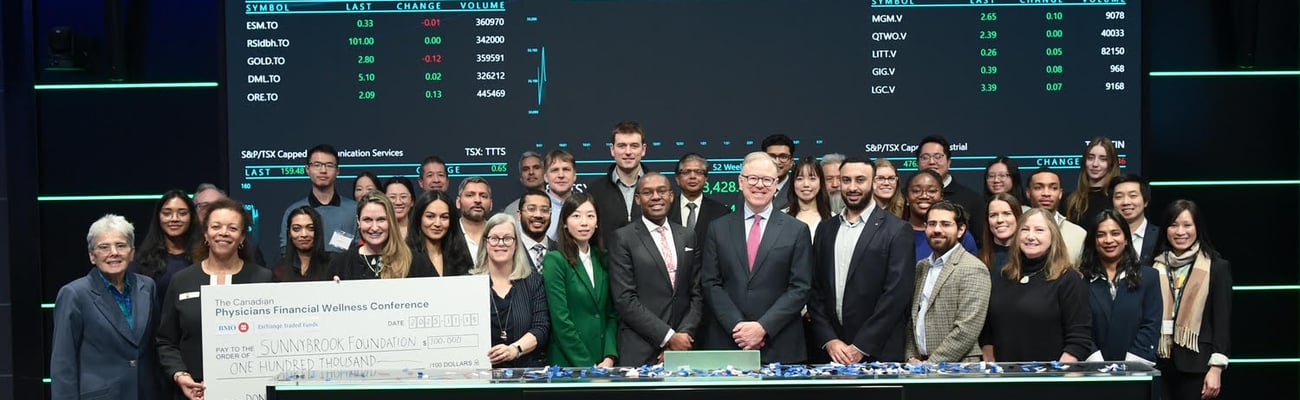
Canadian Physicians Financial Wellness Conference returns this fall
Doctors looking to secure their financial futures and combat burnout can now reserve their spots for the 2026 Canadian Physicians Financial Wellness Conference. Tickets are now on sale for the event via Zoom on Nov. 14 from 1 p.m. to 4:30pm EST. A recording will be available for those who cannot make the time slot.
Conference organizer and moderator Dr. Stephanie Zhou discussed the vision behind the initiative and how the conference empowers physicians with sound financial education below.
Sessions include:
- The Wisest Investment: Teaching Your Kids to Be Responsible, Independent, and Money-Smart for Life (Robin Taub)
- Estate Planning and Retiring from Medicine: Key Tax and Legal considerations (Mariska Loeppky and Dan Britton)
- What to Invest in Each Account (Dr. Mark Soth)
- Tips from a Clinic Owner: Starting & Running an Efficient Practice (Dr. Anish Mody)
- The Finances of Living Well with Disability: from Insurance to Investment (Dr. Lisa Freeman)
- Panel Discussion: Taking Time off In Medicine: Retiring Early, Sabbaticals & Career Pivots (Panel: Drs. Yatin Chadha, Kieran Nair and Matt Poyner)

Registration is via the conference organizer site and the “Buy Tickets” button. Early bird registration is open from now until Oct. 30. The price is $20 to $120 (depending on medical student to staff physician or non-MDs and early bird status). All conference proceeds, net of speaker and CME fees, are donated to charity, with this year's funds benefiting the Scott Mission.
The Medical Post did an email interview with Dr. Zhou:
Q: With AI and from other sources, don't young doctors all know the basics—"don't get a corporation until you have room to pay; get this kind of insurance when you are young, but not later; know about watching for high management fees with investments, etc."—don't all young-ish doctors basically know that?
While AI can be a valuable resource when it comes to financial and health education, there is a difference between knowing the information versus applying the information to your own situation. In my medical practice (addiction medicine), many of my patients know that smoking and using drugs are bad for their health but knowing the facts often doesn't translate to taking the right actions to improve health.
The bigger challenge here isn’t a lack of financial information. It’s information overload. A new physician can get 10 different opinions from colleagues, social media, advisors, accountants and AI and those sources don’t often agree. The question becomes: which advice applies to me? What should I prioritize? How do I know whether someone is giving me advice because it’s in my best interest?
For example, “incorporate when you have room to pay” sounds simple until you’re trying to figure out what “room” actually means given your income, debt, spouse/partner, practice structure, spending needs and long-term plans. The same goes for insurance: knowing that some coverage is easier or cheaper to obtain when you’re younger is different from understanding what coverage you actually need, what the contract says, and what you can realistically afford.
AI can absolutely help with the information piece. But I see the role of education as helping physicians develop the framework to ask better questions, recognize conflicts of interest, understand trade-offs, and know when they need specialized professional advice.
Q: How did you folks come to put together this event and tell me about the charity?
The Canadian Physicians Financial Wellness Conference was started in 2021 and we are in our sixth year. I work with a diverse team of medical students and trainees to organize it each year. We have over 350 attendees from all over Canada join our virtual conference annually and have partnerships with Professional Association of Residents of Alberta and Ontario Medical Student Association to deliver financial education to their members.
At the time, I had already developed the Financial Literacy Curriculum and Practice Management & Billing curriculum which targets medical students and residents, however there was still a gap in the market for a community of practice for early career to late career physicians who did not get any financial education in training. At this time, my co-lecturers Drs. Jane and Paul Healey were building a group called Physicians Financial Independence on Facebook and we created this conference to bring together people from that community of over 40,000 Canadian physicians and spouses to discuss financial topics of relevance to them.
The conference created a platform that attendees can hear from and meet some of the physician financial influencers all in one space. While I was creating financial content for trainees on Youtube and Instagram (Breaking Bad Debt), my colleagues Dr. Mark Soth was blogging about financial topics for mid to late career physicians on The Loonie Doctor and Dr. Yatin Chadha was creating a financial podcast called Beyond MD. Instead of learning about finances in silos, we created a community to learn from each other and meet financial influencers within and outside of medicine that we normally wouldn't get to hear from as individuals.
Since the first year of the conference, the ticket proceeds have supported local charitable causes related to financial literacy or healthcare. We have donated to Habitat for Humanity GTA, created an endowment fund for needs-based awards for low-income medical students, and funded a women’s health fellowship for family physicians at Sunnybrook Hospital. This year, we selected Scott Mission Shelter as our charity, which serves the homeless community through a wraparound service model. This year, they opened a health clinic that delivers primary care not just in the clinic but also through its food bank programs, shelter and housing and clothing banks. Unfortunately, their health clinic is solely reliant on donations and has a run rate of two years and we would like to support their services for longer. This shelter supported my family when we immigrated to Canada, so it is a full circle moment to be able to give back to them in return.
Q: Do you have any worries about your finances?
As a small business owner where the majority of my income comes from my clinical work, the biggest worry is whether I am healthy enough to sustain that level of work. Having had a health emergency that saw my income drop 70%, having multiple sources of income, insurance and investments acts as protection against that happening again.
Q: What makes you proud of physicians as a group about how they are looking at their personal financial situation these days?
What makes me proud is that I think physicians are increasingly recognizing that financial health is part of physician wellness.
There’s a growing willingness among younger physicians especially to ask questions that previous generations sometimes didn’t feel comfortable asking: about debt, compensation, investing, parental leave, disability, retirement, practice ownership and even whether they want to work full-time for their entire careers.
I also see physicians becoming much more interested in understanding their finances rather than simply handing everything over to someone else. They’re asking, “What am I actually paying? What does this investment mean? Do I understand my insurance policy? Is incorporating actually beneficial for me? What are my options?” That curiosity and willingness to learn is encouraging.
And I think there’s been a healthy shift away from the idea that being a “good doctor” means ignoring money. Physicians can care deeply about their patients and also care about their own financial security. In fact, having financial stability can give physicians more autonomy—the ability to take parental leave, reduce clinical hours, pursue a different career path, take a sabbatical, retire when they want, or simply say no to work that isn't sustainable.
Q: Tell us an anecdote from earlier in your life that changed how you think about personal finance?
Earlier, I mentioned that my family was supported by Scott Mission Shelter when we first immigrated to Canada. Seeing the compassion from strangers who provided me with toys, food, and clothing was a formative experience that shaped my own financial values. Moving from poverty to philanthropy, I consider paying it forward a form of investment as well. By donating to scholarships for low-income learners and creating opportunities for economic mobility in communities, it is an investment into the next generation—these will be doctors who will see me as a patient in the future! Philanthropy is one of the tenets of this conference—just as we teach about paying down debt, investing, we also teach people efficient ways to give back—we instill in attendees that when physicians are financially stable, this enables them to support causes and do work that is meaningful to them.