
Canada’s war on physician paperwork
“Addressing administrative inefficiencies is more than an operational fix. It’s a strategic imperative to protect clinical capacity, enhance physician well-being and ensure timely and equitable care for Canadians.”
—from a January 2026 report by the Canadian Medical Association (CMA) and the Canadian Federation of Independent Business (CFIB).

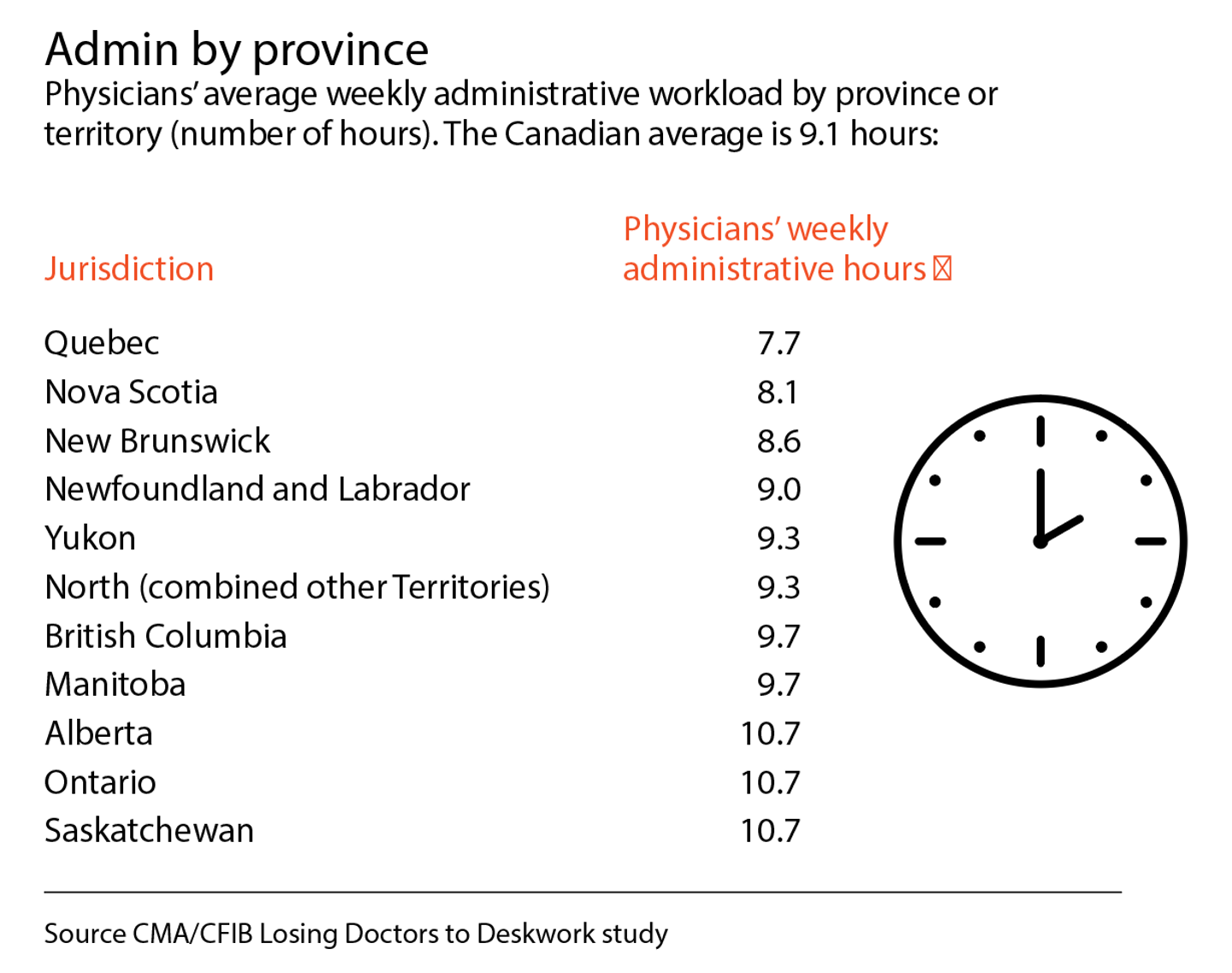
Physicians told the CMA/CFIB Losing Doctors to Deskwork study that they spend nine hours per week on administrative tasks, totalling 42.7 million hours annually across the country. They categorized close to half of that as unnecessary work that could be eliminated or delegated to someone else.
A whopping 93% of the 1,924 doctors participating in the study agreed that the time required to complete administrative work disrupts their work-life balance; 95% agreed that unnecessary paperwork reduces professional fulfillment; and 90% concurred that clinical documentation contributes to burnout. More worrying, over half of physicians said they intend to reduce their clinical hours over the next two years; one in four is considering leaving medicine or retiring earlier than planned; and more than one-third said they would discourage medical students from entering their specialty because of the administrative burden.
Fortunately, the extent of the problem appears to have been heard, and solving it is top of mind for governments, health authorities and technology entrepreneurs. Federal legislation requiring software vendors to comply with interoperability standards is in the queue, artificial intelligence is revolutionizing documentation, inbox management solutions are easing cognitive load, e-referral and central intake are streamlining the referral process and intensive lobbying is underway to simplify, eliminate or standardize the many disability and insurance forms doctors are required to fill out. Even better, technology just around the corner will be able to fill them out automatically.
Forms and more forms
Seventy-eight per cent of doctors responding to the CMA/CFIB study ranked disability and insurance forms, along with health-system processes such as the ordering of tests and referrals as the highest-ranking activities contributing to administrative burnout.
They ranked the federal government’s 16-page disability tax credit (DTC) application as the most burdensome form they have to deal with, complaining they see an average of more than 32 of them each year and that it takes them an average of 36.6 minutes to fill out. The DTC was followed closely by private insurance forms that doctors see an average of 54 times per year and take an average of 28.9 minutes to fill out. Family doctors also have to contend with an average of 136 sick notes per year and 14 Canada Pension Plan disability benefit forms that take 43.3 minutes to complete. To add insult to injury, doctors receive no compensation for close to half of all this form filling.
However, intensive lobbying by the CMA, the CFPC and other healthcare organizations appears to be working. In April, the federal government announced several changes to the application process for the DTC, expanding the number of allied health professionals permitted to certify disabilities and reducing the requirement to certify an individual’s impairment as severe and prolonged for Alzheimer’s, cystic fibrosis, severe forms of sickle cell disease and 40 other conditions. The CMA is also advocating for self-attestation by applicants with physician sign-off, recognition of eligibility assessments for provincial disability support programs, expansion of the simplified, two-page renewal form currently being piloted in Manitoba, compensation for filling out the form and the eventual adoption of an honour-and-audit model, replacing mandatory health professional certification for every application.
The CMA has also worked with the Canada Life and Health Insurance Association to advocate for a standardized, one-page, two-sided form that is rolling out to all their members and has successfully lobbied most provinces and territories to reduce the number of sick notes employees are required to obtain for short term illnesses.
These efforts will reduce the amount of time doctors spend filling out forms, “but I don’t think we will ever get rid of the administrative burden because we still need to collaborate with our colleagues and teams,” said CMA president Dr. Margot Burnell. “We will still need to provide documentation to access drugs that are effective but costly. We will still need to make referrals for caregiver support, but the more standardized it is and the simpler it is, the better.”
AI scribes
According to the CMA/CFIB report, 28% of physicians are using an AI scribe for documentation and report saving an average of 64 minutes per day. Another 42% of physicians expressed an interest in adopting the technology, but AI scribes can do much more than produce a SOAP note.
Dr. Noah Crampton, CEO of Mutuo Health, one of the leading AI scribe vendors in Canada, notes that, “AI is accelerating quickly and competition is hot, so we keep adding more features and functionality.”
Several additional functionalities, including billing code determination, referral processing and even the filling out of insurance and disability forms based on both the interaction between doctor and patient during an appointment as well as the content of the patient chart are in beta testing and due for wider release by year end.
Dr. Crampton, who has a master’s degree in health informatics from the University of Toronto, is also keen on AI evidence lookup, which uses UpToDate and OpenEvidence to automatically suggest clinical questions doctors can ask their patients in real time based on the content of the interaction and the patient chart.
Mutuo Health can also process prescriptions and both lab test and diagnostic imaging requisitions but wants to be cautious about releasing this functionality. “Even if a competitor gets to market before us, I think it’s important that we get it right,” said Dr. Crampton.
The referral burden
Referrals to specialists are singled out in the Losing Doctors to Deskwork report as a top-ranked health-system process contributing to the administrative burden in primary care. According to Ted Alexander, Amplify Care’s vice-president, partnerships and clinical innovation, doctors using traditional referral workflows complain about identifying the most appropriate specialist to send a referral to and transferring clinically relevant information from their point-of-care system to the referral note. They have no knowledge of specialist wait times or sub-specialties and they aren’t always certain that a faxed referral was successfully received and accepted. The patient information provided in the referral note may not be sufficient for the specialist, so instead of a simple “do it and forget it” task, a referral can easily get bogged down in repeated phone calls and faxes back and forth. In the worst-case scenario, there’s a risk of patient harm if a specialist is on sabbatical or the faxed referral is never received and there is no followup.
Amplify Care (in its former branding as the eHealth Centre of Excellence) pioneered an e-referral network using OceanMD technology in the Kitchener-Waterloo area of southwestern Ontario that has expanded across the province and to other jurisdictions across the country. It still only accounts for 1.3 million of Ontario’s total volume of 9.5 to 10 million referrals processed annually, admitted Alexander.
E-referral is easier and more efficient to use because it provides wait-time and sub-specialty information. It launches within the patient chart and automatically populates standardized, specialty-specific referral forms with patient and provider information. It also allows a family physician to append other information the specialist requires from the patient chart and enables messaging between family physician, specialist and patient so everyone is in the loop and knows what’s happening.
In Ontario, OceanMD’s technology is integrated with most EMRs and two-thirds of family physicians are on the e-referral network. However, only one-third of specialists have access to it, according to Alexander, because many specialists are hospital-based and not all hospital information systems are integrated with OceanMD’s technology.
Alexander points to Thunder Bay Regional Health Science Centre’s Surgical Central Intake system that uses an integration of Novari Health’s central intake technology and OceanMD’s e-referral solution as a model for the rest of the province. “If you’re a doctor in Thunder Bay or anywhere in northwestern Ontario, you can initiate a referral inside your EMR by using Ocean to pick a specialist you want or use central intake,” said Alexander. As part of its Patients Before Paperwork initiative, Ontario Health has executed a multi-year agreement with Novari to extend its central intake solution to other regions of the province, which will ultimately allow all referrals to be processed electronically.
Top solutions
Strategies physicians rank highest for reducing administrative burden:
72% Eliminating the requirement for physicians to perform some administrative tasks
71% Securing interoperability of patient care records/connected care
70% Mandating insurer reforms to simplify claims and authorization processes
67% Allowing other health professionals to handle physicians’ administrative tasks
67% Providing physicians with protected, paid administrative time in contracts
61% Eliminating sick notes (for short-term minor illnesses)
59% Streamlining, combining or simplifying federal, national and provincial forms
55% Increasing remuneration for time spent completing federal and national forms
54% Integrating all forms into the electronic medical record
53% Simplifying billing and payment systems
51% Introducing centralized referral systems to minimize redundant paperwork
51% Reducing medico-legal documentation requirements (where clinically safe)
45% Adopting artificial intelligence (e.g., AI scribes and AI-powered agents and tools)
43% Moving toward team-based care practice models
38% Having a one-stop shop for all forms in Canada with an integrated billing tool
Source CMA/CFIB Losing Doctors to Deskwork study
eFax and email overload
Processing the hundreds of emails and faxes primary care clinics receive on a daily basis also contributes to administrative burden, but here too, technology is coming to the rescue. Phelix.AI, a technology startup founded by Hassaan Ahmed, developed an AI-powered agent that crawls through unstructured faxes, classifies them, identifies the sending physician, the intended recipient and other pertinent details, freeing medical office assistants from having to manually sort through them. It also pushes documents to the correct patient chart and to the right provider. Not stopping there, Phelix.AI is now in the process of developing Ambient Inbox, a browser agent that physicians can use to manage their EMR inbox.
Clinicians with 100 new inbox items to go through don’t just look at an email to decide on a prescription refill, for example, and move on to the next one, explained Ahmed. “They need full context. They have to go into the patient chart to see what lab results came in.” Ambient Inbox will save time by classifying the inbox item and accessing the patient chart to summarize and display the relevant information. By the time the physician is ready to go through the inbox, the necessary context will already have been collected and displayed. Ahmed hopes to have an initial version of Ambient Inbox available for testing by June.
OpenClaw, a popular browser agent, is experiencing explosive growth in industries other than healthcare, said Ahmed. It’s an open-source, self-hosted AI agent and virtual assistant. Unlike AI chatbots like OpenAI or Gemini that just answer questions, OpenClaw is designed to autonomously execute tasks on a computer. Aside from managing inboxes, it can fill out forms like the DTC or referral letters and prepare physicians for upcoming appointments by summarizing information from the patient chart. However, while OpenClaw has the potential for automating administrative tasks, tech experts warn that its adoption in healthcare will have to be carefully managed to protect personal health information.
Health Report Manager
Every month, Ontario’s Health Report Manager (HRM) delivers 3.5 million reports and other communications from hospitals to primary care physician inboxes, but many of them are non-clinical e-notifications, updates or duplicates because many hospitals have traditionally sent HRM reports as both emails and faxes. The good news is that e-notifications can be turned off by filling out a simple form on the OntarioMD website. To date, only 800 of Ontario’s 16,500 primary care clinicians have done so, suggesting most doctors either still want them or are too busy to take the time to stop them. Doctors can also ask hospitals in their area to stop sending duplicate faxes. Some hospitals have cited technical challenges for not being able to do so, but Matt Leduc, OntarioMD executive director, products, integrations and service management, says most hospitals are now able to turn them off and it is estimated that only 10% of HRM recipients are still getting them.
HRM updates can also be minimized. “We found through our analysis of HRM data that in the first six hours of a report being produced there are a number of updates as a result of normal workflow,” said Leduc. “The first six hours accounts for a disproportionate number of duplicates and near matches, so we’re asking hospitals to delay sending a report for six hours and only send the most up-to-date version.”
Suspending the distribution of HRM reports for six hours is more technically challenging, but Lakeridge Health serving Ontario’s Durham Region west of Toronto has implemented it and Oracle-Cerner has built the six-hour delay and the ability to turn off faxed duplicates into their core functionality for Ontario hospitals.
In August, OntarioMD conducted a four-week trial of another software solution that identifies key content from an HRM PDF report and populates it in a metadata field that’s searchable by an EMR.
“When doctors receive a PDF in their EMR, it’s largely the equivalent of a closed envelope,” explained Leduc. “If your patient has had a colonoscopy and you conduct a search for the result in a PDF report without opening that envelope, you’re not going to find it.” However, with the key words from the PDF in a searchable page zero, doctors will be able to find it using the EMR’s search functionality.
“What is more common are updates,” added Leduc. “You get a report, then you get a correction or additional recommendations for the patient. Currently, doctors don’t know if it’s an update or a dupe, and if it’s an update, what has changed, so it’s necessary to do the equivalent of a time-consuming line-by-line comparison. What we’re implementing is something that specifically identifies the change. That will be a big win for doctors because it reduces their cognitive load. They don’t need to figure out if it’s an update or a dupe and if it’s an update, they just need to focus on the change and not have to read it all.”
The trial yielded some very positive results along with some opportunities for improvement and next steps are currently under consideration, said Leduc.
Conclusion
According to the CMA/CFIB report, eliminating the estimated 19.8 million hours of unnecessary administrative work Canadian doctors currently perform every year could add capacity comparable to more than 9,000 full-time physicians. Asked how they would use the time saved, 79% of doctors said they would invest it in work-life balance, 44% said they would spend more time with their existing patients and 43% said they would take on additional patients.
It’s still to be determined whether all of the timesaving solutions currently in the works will suffice to restore the joy of practising medicine, but the extent of the problem has been acknowledged and there is at least some justification for optimism.